
Tale of Inclusion: Down Syndrome and Violence at the Play Area
Now he does it all the time. I’m so proud of his physical and social development, but I’m still always worried something will go wrong. So far mostly so good, but your story reminds me of the challenges.
Second – I was struck by how often you talked about feeling shame. Other parents were looking at you, you felt like a bad mother, but you know that you didn’t do anything wrong. It’s not a good feeling. Here’s something to consider – That shame you were feeling, the shame that the other parents are looking at you and blaming you, parents of kids with disabilities live with that shame all the time. It can get really oppressive, making parents like us self-isolate. We just stay home, keeping our kids out of the grocery store, playground, or even school.
I’ve felt it, I feel it all the time when my son acts in a non-typical way, or his nose is too runny and people are judging me, when he shouts in the barber shop, when he dances randomly in the mall, I encounter so many micro-aggressions on a day-to-day basis that you’d think I’d be used to it, but no. I still feel shame.
So I’m asking you, as a parent, to think about that emotion you felt, to know that you were in the right here, but to approach those parents with compassion and empathy.
So now what? I operate under the principle of inclusion, but not same-ness. My goal is to have your son and the boy with DS included together, safely, in the play-space. That doesn’t mean consequence-free violence, but it also doesn’t mean that you can respond to the incident as you would for other kids, because the usual methods of parental reaction – yelling (sadly), time-outs, removal of privileges – might not have any meaning. Yeah, a parent can take away a toy or fun activity from a four-year-old with Down syndrome, but depending on their developmental level, it might not have any meaning. How do you connect the consequence to the act of hurting your son? That’s the challenge here.
The first step is to understand what might have happened. What does the violent behavior – pinching, tripping, hitting – mean in this case? Does it come from anger? Aggression? Confusion? Fear? Sometimes it’s from over-stimulation. Or, and this is pretty common, people with Down syndrome use physical responses as an alternate form of communication. When you don’t have words, hitting or hugging communicates perfectly well from the perspective of the child, and it might not even communicate what you think it does.
People with Down syndrome are not any more likely to be violent by nature than anyone else, in fact probably less so, but they do often have boundary issues. Maybe the parents knew their child was violent, as you say, but maybe not. We – parents – are often surprised by our children’s response to situations. I knew a boy who liked to grab hair and pull – it was an interesting texture and sensation for him. My son often pushes hands away, sometimes slapping, when he’s angry or frustrated. One time my son Nico was so afraid of splashing water that he reached out and grabbed my face with his hand, cutting the skin with his nail, terrified. That’s violent, but different than fighting from aggression or anger, or from knocking someone down because you’re playing ninja and don’t have good control.
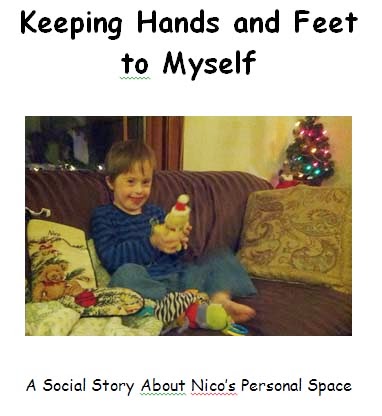
One technique we’ve used with Nico is the social story. They are picture and word-based behavioral stories that try to make sure a person understands a situation and the consequences of actions, to help them make better decisions in the future. They use a lot of positive affirmation and perhaps one or two pieces of instructional advice to try and achieve better response to situations. Therapists make them for their patients, though parents can make them as well. Here, for example, is a story about playing nicely with a brother, easily adapted for a public playground. Here’s another. Social stories have worked wonders for my son, but each kid is different.
Comfort your son and comfort yourself! I’m sorry that people looked at you as if you were a horrible parent, but don’t let them get you down! People judge all the time and are usually clueless about context; ultimately, the opinions of strangers aren’t that important (to me anyway). Remember that no outsider ever has a clue about what’s going on in a family and try to just do what’s right.
Engage the parents. Tell them what happened. I would be devastated to know my son hurt another child, and so might they. Remember that raising a child with special needs is pretty difficult, so once you have calmed yourself and your child, engage with empathy.
I would say something like, “I know you’ve got a lot of challenges, but I felt it was important to tell you that that your child hurt my child today in the play area. Is there a way we can talk to him about more appropriate play? Is there anything that I or my son can do to help?“
In the end, I’m really sorry that your son got hurt.
I hope, though, that this is a moment that can lead towards a more inclusive society, not away from it. Inclusion, not same-ness. We don’t respond to this boy hurting your son the same way that we might from another child. Same-ness just won’t accomplish anything. But we DO respond. We must respond, and respond with dialogue, patience, creativity, and empathy.
DEAR READERS PLEASE NOTE – The person with the comment and I have exchanged emails and I anticipate she will read this blog. If you are rude in comments, I will simply delete your post without warning! It’s fine to disagree thoughtfully, I’d love to hear better ways of framing a response, but no rudeness to someone genuinely looking for help.